
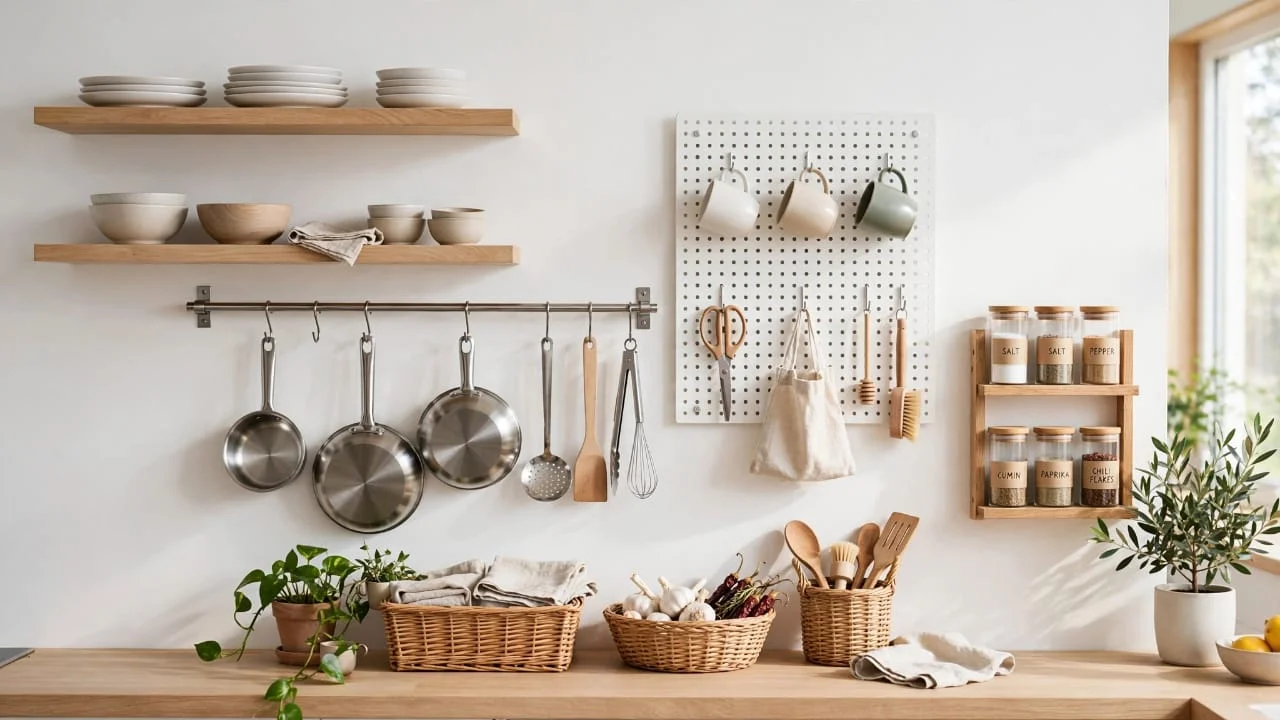
Traditional overhead cabinets aren’t the only way to have a functional, tidy kitchen that makes the space feel lovely. There are so many versatile pieces on the market these days; a good combination of open shelving, rolling carts, wall storage, countertop organizers, hooks, baskets and stand-alone furniture can be an essential way to maximize your cooking space — even when cabinet space is scarce.
Apartment, studio apartment, tiny home, older kitchen and spaces that are not conducive to permanent cabinetry work well with Kitchen organization without cabinets. The entire goal is to ultimately avoid the hiding of everything behind cupboard doors, and having a place for all your daily essentials while also taking advantage of vertical storage and dead zones.
This guide details incredibly useful small kitchen organization without cabinet products and ideas as well as practical organization methods for cookware, dishes, spices, pantry items and countertop appliances.
Why Kitchen Organization Without Cabinets Can Work
Welcome to the best of both worlds — traditional cabinets offered a great storage solution however, isn’t the only solution in this post. Not having as much cabinet space may force you to make decisions on what stays and goes.
Open shelving enables you to keep your dishes on display even while keeping them in reach. A stationary or rolling kitchen cart can add to work space, as well as provide a storage location. You can store utensils on wall-mounted rails and free standing shelving can serve for part of the storage cabinets normally have.
The secret is to divide the kitchen into functional areas.
For example:
- Cooking zone: Pots, pans, utensils, oils, and spices
- Prep zone: Cutting boards, knives, bowls, and food-preparation tools
- Cleaning zone: Dish soap, brushes, towels, and cleaning supplies
- Pantry zone: Dry foods, cans, jars, and snacks
- Appliance zone: Coffee makers, air fryers, blenders, and other countertop appliances
This approach makes kitchen organization without cabinets more practical because everything has a designated place.
Best Storage Solutions for Kitchen Organization Without Cabinets
| Storage Solution | Best For | Main Benefit | Space Needed | Best Kitchen Type |
|---|---|---|---|---|
| Freestanding Shelving | Dishes and pantry items | Large storage capacity | Floor space | Small to large |
| Rolling Kitchen Cart | Appliances and supplies | Storage + mobility | Floor space | Small kitchens |
| Open Shelves | Plates and glasses | Easy access | Wall space | Any kitchen |
| Pegboard Organizer | Utensils and cookware | Customizable wall storage | Wall space | Small kitchens |
| Wall Rail System | Utensils and tools | Uses vertical space | Wall space | Compact kitchens |
| Stackable Bins | Pantry products | Groups small items | Shelf/floor space | Small kitchens |
| Over-Counter Shelf | Everyday dishes | Adds vertical storage | Countertop | Tiny kitchens |
| Hanging Baskets | Produce and small supplies | Saves floor space | Wall/ceiling area | Small kitchens |
1. Freestanding Kitchen Shelving
Freestanding shelves are one of the best solutions for cupboards.
A shelving unit that reaches up to the ceiling can offer a number of additional paddles for plates, bowls, glasses, cooking supplies, storage containers and appliances as well as decorative pieces.
Freestanding shelves can usually be relocated and refashioned when your needs dictate unlike permanent cabinets.
Key Features
- Multiple storage levels
- No cabinet installation required
- Available in different sizes
- Useful for dishes and pantry items
- Can store appliances
- Easy to rearrange
Pros
- Provides substantial storage
- Uses vertical space
- Suitable for renters
- Easy to customize
- Available in many designs

Cons
- Contents remain visible
- Requires floor space
- Open shelves can collect dust
- Heavy items require sturdy construction
For small kitchen organization without cabinets, choose a tall and narrow shelving unit if floor space is limited.
You can also use attractive baskets or storage bins on lower shelves to keep smaller items contained.
2. Rolling Kitchen Cart
A mobile kitchen cabinet is just another fantastic option.
It not only offers extra storage but also serves as a mobile workspace. Some carts have shelves, drawers or baskets or just a counter top depending on the design.
To store cookware, small appliances, pantry items and necessary tools for making coffee or kitchen gadgets that you get many uses out of.
Features
- Wheeled design for easy movement around the kitchen
- Multiple storage shelves for cookware, dishes, pantry items, or appliances
- Compact footprint suitable for small kitchens
- Extra countertop space for food preparation or serving
- Locking wheels on many models for added stability
- Open shelving for quick access to frequently used items
- Easy to reposition when you need more floor space
Pros
- Mobile storage
- Adds countertop space
- Useful in small kitchens
- Easy to reposition
- Can separate kitchen zones

Cons
- Requires floor space
- Wheels need a stable surface
- Capacity varies by model
A rolling cart is particularly useful in a small apartment because you can move it when you need more space.
3. Open Kitchen Shelves
The most popular kitchen without cabinets ideas include open shelving.
Open shelves help keep everyday items visible and accessible rather than hid behind doors.
Shelves: Plates, bowls, mugs glasses jars or decorative pieces can be neatly arranged on shelves.
The thing is not to overfill them.
Try to use matching containers wherever possible and group items by category This gives shelves a more streamlined look and makes them easier to work with.
Features
- Wall-mounted storage that uses vertical space efficiently
- Easy access to plates, bowls, mugs, glasses, and kitchen essentials
- Space-saving design ideal for small kitchens without cabinets
- Open display makes frequently used items easy to see
- Multiple shelf levels provide flexible storage options
- Versatile organization for dishes, spices, jars, and decorative items
- Cabinet-free solution that can make a small kitchen feel more open
Pros
- Easy access
- Uses wall space
- Attractive display
- No cabinet doors to open
- Good for everyday dishes

Cons
- Requires wall installation
- Items are exposed to dust
- Can look cluttered if overfilled
If you rent your home, freestanding shelves may be a better option than permanently mounted shelving.
4. Pegboard Kitchen Organization
The most popular kitchen without cabinets ideas include open shelving.
Open shelves help keep everyday items visible and accessible rather than hid behind doors.
Shelves: Plates, bowls, mugs glasses jars or decorative pieces can be neatly arranged on shelves.
The thing is not to overfill them.
Try to use matching containers wherever possible and group items by category This gives shelves a more streamlined look and makes them easier to work with.
Features
- Customizable peg system for arranging hooks and holders
- Vertical wall storage that saves valuable counter space
- Flexible layout for utensils, pans, cutting boards, and tools
- Easy access to frequently used kitchen items
- Expandable design that can be rearranged as storage needs change
Pros
- Saves countertop and cabinet space
- Highly customizable storage
- Keeps frequently used tools visible
- Great for small kitchens
- Works well for DIY organization

Cons
- Requires suitable wall space
- Some installations need drilling
- Exposed items can collect dust
- Weight capacity varies by pegboard system
- Can look cluttered if overcrowded
5. Wall-Mounted Rail System
A wall rail offers a different opportunity to use the vertical space.
attach hooks, baskets, and holders to store utensils, towels measuring tools, and often used cooking equipment.
This is a great feature to have if you are short on counter and floor space.
Rather than storing every single instrument in a container on the counter, some matters can be set onto the wall.
Features
- Wall-mounted design uses unused vertical space
- Multiple hooks for utensils, mugs, and kitchen tools
- Adjustable accessories can be repositioned as needed
- Space-saving solution for kitchens without cabinets
- Easy-access storage keeps everyday items within reach
Pros
- Saves valuable counter space
- Ideal for small kitchens
- Keeps utensils organized and visible
- Flexible storage arrangement
- Easy access to frequently used tools

Cons
- Requires suitable wall space
- Some systems require drilling
- Exposed items may collect dust
- Weight capacity varies by model
- Can look cluttered when overloaded
How to Organize a Small Kitchen Without Cabinets
When working with a small kitchen, start by determining what you actually need to store.
Remove duplicate utensils, unused containers, broken items, and appliances you rarely use.
Then divide everything into categories.
Next, identify unused areas:
- Empty walls
- Corners
- Gaps between appliances
- Countertop space
- Door surfaces
- Floor-level areas
- Vertical space
Once you identify these areas, select storage solutions that fit them.
The goal isn’t to fill every available space. Instead, create enough storage to keep your essential items organized without making the kitchen feel crowded.
Kitchen Without Cabinets Ideas for Renters
Renters may not be able to install permanent cabinetry, but there are still many ways to improve storage.
Freestanding shelves, rolling carts, tension rods, removable hooks, countertop shelves, and baskets can all provide flexible storage.
Before using adhesive products, always check the manufacturer’s instructions and make sure the surface is suitable.
Freestanding furniture is often the easiest option because it doesn’t permanently alter the kitchen.
Kitchen Organization Without Cabinets DIY
If you enjoy DIY projects, you can create customized storage using simple materials.
A wooden pegboard can become a utensil wall.
A narrow wooden shelf can become a spice rack.
A rolling cart can become a mobile pantry.
Wooden crates can become stackable storage, provided they are stable and appropriate for the weight being stored.
DIY organization works best when it solves a specific problem.
Don’t build storage simply because you have an empty wall. First decide what needs to be stored and how often you need to access it.
How to Keep a Cabinet-Free Kitchen Looking Organized
Because open storage exposes everything, visual organization becomes important.
Use matching baskets or containers where practical.
Group similar items together.
Avoid overcrowding shelves.
Keep frequently used products within easy reach.
Store less attractive packaging inside baskets or containers.
Choose a consistent arrangement for plates, bowls, glasses, and mugs.
You don’t need every item to match, but creating repeated patterns can make an open kitchen feel more organized.
Common Mistakes to Avoid
Using Every Inch of Wall Space
More storage isn’t always better.
Too many shelves can make a small kitchen feel crowded.
Overloading Open Shelves
Heavy stacks can be difficult to access and may create safety concerns.
Ignoring Measurements
Always measure the available area before buying furniture or organizers.
Keeping Too Many Appliances
Countertop appliances can quickly overwhelm a cabinet-free kitchen.
Keep the appliances you use regularly and store occasional-use appliances elsewhere if possible.
Forgetting Cleaning
Open shelves and exposed storage require regular dusting and cleaning.
Choose easy-to-clean materials for areas near cooking surfaces.
Final Thoughts
Kitchen organization without cabinets is completely possible when you approach storage strategically.
Instead of relying on traditional cabinetry, combine freestanding shelves, rolling carts, open shelving, wall rails, pegboards, baskets, countertop organizers, and vertical storage.
The most important principle is to make every storage solution serve a purpose.
If you have a small kitchen, focus on vertical space and multi-functional furniture. If you’re renting, prioritize movable and removable solutions. If you enjoy DIY projects, customize unused walls and awkward spaces.
A well-organized kitchen isn’t necessarily the kitchen with the most storage. It’s the kitchen where everything has a logical home and the things you use most are easy to reach.
Frequently Asked Questions
How do you organize a small kitchen without cabinets?
Use freestanding shelves, rolling carts, open shelving, pegboards, wall rails, baskets, and countertop organizers. Focus on vertical space and keep frequently used items easily accessible.
What can I use instead of kitchen cabinets?
You can use freestanding shelving, kitchen islands, rolling carts, open shelves, storage racks, baskets, pegboards, and wall-mounted organizers.
How do I organize a kitchen with no storage?
Start by decluttering, then use unused walls, corners, vertical areas, and floor space. Add freestanding shelves, carts, racks, and baskets to create dedicated storage zones.
How do I organize a small kitchen without cabinets?
Prioritize vertical storage. Use open shelves, narrow shelving units, wall-mounted rails, pegboards, rolling carts, and stackable containers to maximize the available space.
Are open shelves good for a kitchen without cabinets?
Yes. Open shelves can provide accessible storage for dishes, glasses, spices, and pantry containers. However, they should not be overloaded and require regular cleaning.
How can I organize kitchen counters without cabinets?
Use a compact shelf, rolling cart, wall rail, pegboard, or vertical organizer to move frequently used items away from the main work surface.
What is the best storage for a kitchen without cabinets?
There isn’t one universal solution. A combination of freestanding shelving, rolling carts, open shelves, baskets, and wall storage usually provides the greatest flexibility.
Can I organize a kitchen without drilling?
Yes. Freestanding shelves, rolling carts, countertop shelves, baskets, and some removable storage products can provide organization without permanent drilling. Always check product instructions before using adhesive or tension-based systems.
How do I make a cabinet-free kitchen look less cluttered?
Group similar items, use matching baskets or containers, avoid overcrowding shelves, and keep frequently used items accessible. Store small miscellaneous items inside labeled bins.