
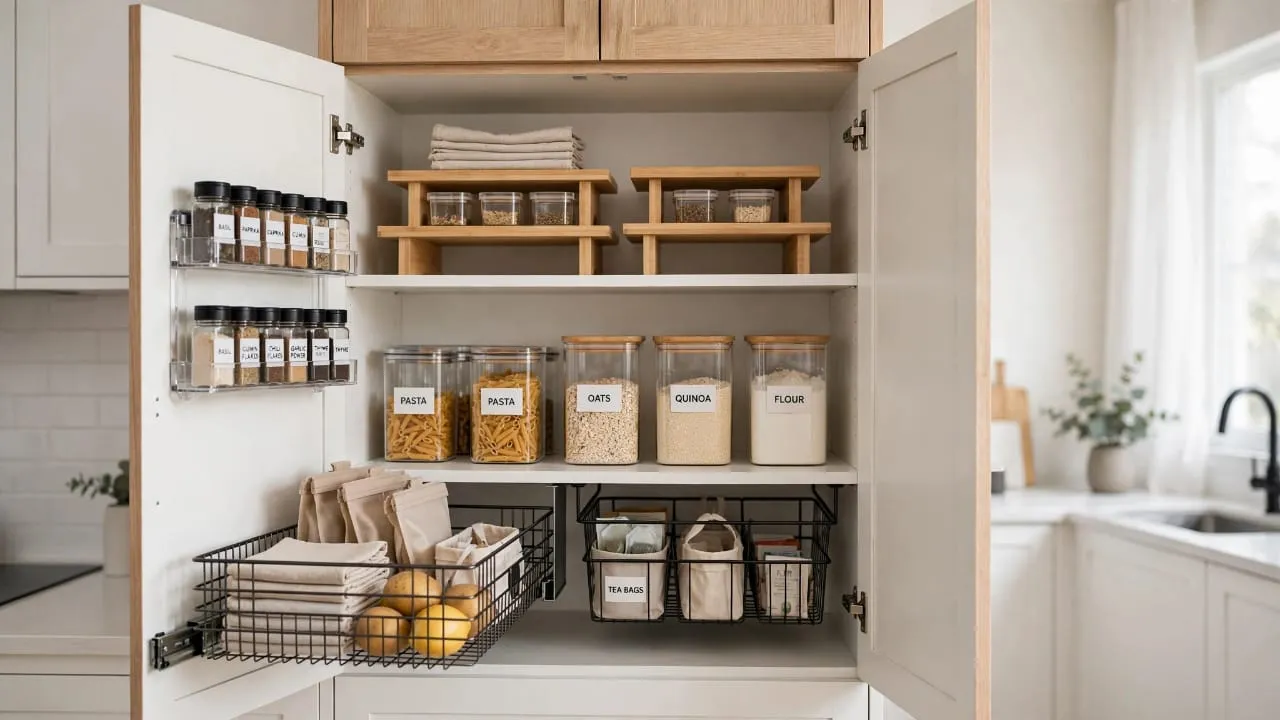
Kitchen cabinet organization makes a world of difference on how light and easy (or hard) your kitchen is to work in. Even a well-crafted kitchen can be difficult if you have plates, frying pans and baking dishes shoved into crowded shelves along with packets of spices, cleaning supplies and tools.
The good news is you probably do not need to be carrying out a complete kitchen remodel in order to improve your storage. Basic items like cabinet organizers, shelf risers, pull-out mechanisms, drawer solutions and adjustable storage units provide you with the ability to more thoroughly utilize space currently in your home.
In this guide, we are going to review five useful products that can assist you in organizing your kitchen cabinets, as well as elaborate on which type of organizer is most appropriate where. We will discuss step by step how to organize your kitchen cabinets, decide on storage items and common organization pitfalls.
Why Kitchen Cabinet Organization Matters
Kitchen cabinets generally hold a combination of common dishes, pans and pots, appliances, pantry essentials, food storage containers along with other random kitchenware. Without a system, things can quickly get lost.
Kitchen cabinet organization Where To Start With Organizing Your Kitchen
Put frequently used items within reach.
Group similar items together.
Utilize vertical and unused cabinet space
Take plates, for instance; they can be clustered together close to the dishwasher— or near to areas set aside for food-preparation establishments. You can put spices next to the stove and keep food containers without having to move objects from one cabinet too many times.
The goal is not only to make cabinets beautiful. An organized cabinet should facilitate cooking, cleaning and putting things away.
5 Kitchen Cabinet Organization Products at a Glance
| Product | Best For | Main Benefit | Ideal Cabinet Area | Organization Style |
|---|---|---|---|---|
| Adjustable Shelf Organizer | Plates, bowls and cookware | Creates extra vertical levels | Upper/lower cabinets | Vertical storage |
| Pull-Out Cabinet Organizer | Pots, pans and supplies | Makes deep cabinets easier to access | Lower cabinets | Pull-out storage |
| Under-Sink Organizer | Cleaning supplies | Uses difficult under-sink space | Sink cabinet | Tiered storage |
| Cabinet Door Organizer | Wraps, spices and small items | Uses unused door space | Cabinet doors | Door storage |
| Expandable Cabinet Shelf | Dishes, cans and containers | Adjusts to available width | Upper cabinets | Adjustable storage |
1. Adjustable Kitchen Cabinet Shelf Organizer
One of the easiest ways to help with kitchen cabinet organization is by using an adjustable cabinet shelf organizer. A shelf riser redirects plates, bowls, cans or cookware from stacking directly on top of one another to adding an extra level inside the cabinet.
This makes commonly utilized products more visible and reachable.
So, for instance, if you have a gap of vertical space above your dinner plates in your dining room cabinet, a shelf can make that part of the closet more useful.
Key Features
- Adds an additional storage level
- Uses vertical cabinet space
- Suitable for dishes and bowls
- Useful for cans and food containers
- Adjustable designs are available
- Can work in different cabinet sizes
Pros
- Simple organization solution
- Makes better use of vertical space
- Helps prevent unstable stacks
- Easy to reposition
- Useful for many cabinet types

Cons
- Takes up some horizontal space
- Weight capacity varies
- Fixed-height versions may not fit every cabinet
Who Should Use It?
Shelf organizers are particularly useful if your cabinets are tall but your items are relatively short.
Instead of having one shelf with a pile of plates and several inches of unused air above them, you can create a second storage level.
This is one of the easiest kitchen cabinet organization ideas because it doesn’t require permanent installation.
2. Pull-Out Cabinet Organizer
Deep lower cabinets are one of the hardest places to keep organized. Near the back it can become impossible to see or access items, meaning supplies fall to the back of cupboards and the clutter builds up unnecessarily.
A pull-out cabinet organizer solves this issue by enabling the storage portion to pull towards you.
This is especially good for pots, pans, food-storage containers, cleaning products and pantry supplies.
Key Features
- Sliding or pull-out storage
- Easier access to deep cabinets
- Available in different widths
- Useful for lower cabinets
- Can improve visibility
- Some models include multiple levels
Pros
- Makes deep cabinets easier to access
- Reduces reaching and searching
- Helps use the full cabinet depth
- Useful for heavy kitchen supplies
- Can improve cabinet visibility

Cons
- Some models require installation
- Cabinet dimensions must be measured carefully
- Hardware quality varies
- More expensive than basic shelf risers
Who Should Use It?
A pull-out organizer can be especially valuable for kitchens with deep cabinets where items tend to disappear toward the back.
Rather than removing several objects to reach one item, you can pull the storage section forward and see more of its contents.
For people who struggle with awkward lower cabinets, this can be one of the most useful kitchen storage upgrades.
3. Under-Sink Cabinet Organizer
The cabinet under the kitchen sink can be a tough spot to get in order—pipes take away precious room.
Instead of letting cleaning products, sponges, brushes trash bags, and other supplies turn into one massive mound, an under-sink organizer organizes items into separate sections.
Key Features
- Designed for under-sink storage
- Tiered or stacked configurations
- Useful for cleaning supplies
- Helps work around plumbing
- Available in different sizes
- Some models include removable bins
Pros
- Makes use of awkward space
- Separates cleaning supplies
- Improves visibility
- Helps reduce clutter
- Can create multiple storage levels

Cons
- Plumbing can limit available space
- Measurements are especially important
- Some designs may not work with every sink cabinet
Who Should Use It?
If the area underneath your sink is crowded or difficult to access, this type of organizer can make a significant difference.
Before purchasing, measure the cabinet’s width, depth, and height. Also check the location of the plumbing pipes and disposal unit.
The goal is to select an organizer that works around the existing plumbing rather than trying to force the cabinet to accommodate a product that doesn’t fit.
4. Cabinet Door Organizer
Cabinet doors are a frequently overlooked source for storage potential.
A cabinet door organiser is one that you can attach or hang onto the inside of a cabinet door and bring unused space in your cabinets to life with increased storage for smaller kitchen items.
Depending on the design, it can be used to hold spices, wraps, cutting boards, cleaning supplies, food-storage bags or other lightweight items.
Key Features
- Uses inside cabinet-door space
- Suitable for small kitchen supplies
- Available in different designs
- Helps free shelf space
- Useful for narrow items
Pros
- Uses otherwise unused space
- Keeps small items visible
- Frees up cabinet shelves
- Useful for compact kitchens
- Can create additional storage

Cons
- Door clearance must be checked
- Heavy items may not be suitable
- Some designs require screws or adhesive
- Cabinet-door thickness can affect compatibility
Who Should Use It?
A cabinet door organizer is particularly useful when your shelves are already full but the inside of the cabinet door has unused space.
However, always check whether the organizer will interfere with shelves, hinges, or items stored inside the cabinet.
5. Expandable Cabinet Shelf
Expandable cabinet shelf: an expandable cabinet shelf has the added advantage of flexibility; you can adjust its width to fit in various spaces of your cabinets.
This makes it practical for individuals that don’t desire to dedicate to an organizer of a certain size.
For dishes, bowls, cans, mugs, food containers or other things inside the kitchen can be placed on expandable shelves according to what weight does it has.
Key Features
- Adjustable width
- Flexible cabinet placement
- Useful for dishes and pantry products
- Creates additional storage levels
- Available in different sizes
Pros
- Adjustable design
- Flexible placement
- Makes better use of vertical space
- Suitable for different cabinet sizes
- Easy to reposition

Cons
- Weight capacity varies
- Some models may shift if overloaded
- Not every design is suitable for heavy cookware
Who Should Use It?
Expandable shelves are a good choice when cabinet dimensions vary or when you want an organizer that can be adjusted after installation.
They can also be useful for renters because many versions don’t require permanent modifications.
What Is the Best Way to Organize Kitchen Cabinets?
The best way to organize kitchen cabinets is to start by removing unnecessary items, grouping similar products together, assigning storage zones, and using organizers to make better use of available space.
Instead of organizing randomly, think about how you use your kitchen.
For example:
Cooking zone:
Keep pots, pans, cooking utensils, oils, and frequently used ingredients near the stove.
Food-preparation zone:
Store cutting boards, knives, mixing bowls, and food-preparation tools near the main countertop workspace.
Cleaning zone:
Keep dish soap, sponges, brushes, dishwasher supplies, and cleaning products near the sink.
Storage zone:
Keep food containers, wraps, bags, and pantry products together.
This approach is sometimes called zone-based kitchen organization, and it can make a kitchen much easier to navigate.
What Are the 4 Steps to Organize Kitchen Cabinets?
The four basic steps are:
Step 1: Empty the Cabinets
Remove everything from the cabinet or cabinet section you are organizing.
This allows you to see exactly what you own and gives you a clean starting point.
Step 2: Declutter and Group
Separate items you use regularly from things you rarely or never use.
Then group similar items together, such as:
- Plates
- Bowls
- Glasses
- Pots
- Pans
- Food containers
- Spices
- Cleaning products
Step 3: Create Storage Zones
Decide where each category should live based on how frequently and where you use it.
Frequently used items should be placed in easy-to-reach locations.
Step 4: Add Organizers and Put Everything Back
Now introduce shelf risers, pull-out organizers, bins, dividers, or cabinet-door storage where they solve a specific problem.
Avoid buying organizers before measuring your cabinets.
What Are the 4 Steps for Organizing Kitchen Cabinets?
The same four-step system can be summarized as:
Declutter → Categorize → Zone → Organize
First, remove unnecessary items.
Second, categorize everything that remains.
Third, assign each category a logical location.
Finally, use storage products to make the available space more efficient.
This method is much more effective than simply purchasing several containers and hoping they solve the clutter problem.
What Are 4 Easy Steps to Organize Kitchen Cabinets?
If you want a quick approach, follow these four simple steps:
- Take everything out
- Get rid of items you don’t need
- Group similar items together
- Return them using shelves, bins, dividers, and organizers
Start with one cabinet rather than attempting to reorganize the entire kitchen in one day.
Once you establish a system that works, repeat it throughout the rest of the kitchen.
Kitchen Cabinet Organization Ideas for Small Kitchens
Small kitchens require a slightly different approach because every inch of storage matters.
One of the best strategies is to use vertical space.
Shelf risers can create additional levels inside cabinets, while cabinet-door organizers can turn unused door surfaces into storage.
Another useful strategy is to prioritize items based on frequency of use.
Keep everyday dishes, glasses, cooking utensils, and frequently used ingredients in accessible locations. Items used only occasionally can go toward the back of cabinets or into higher storage areas.
You can also consider:
- Stackable containers
- Expandable shelves
- Slim organizers
- Pull-out baskets
- Door-mounted racks
- Vertical dividers
- Under-sink organizers
- Corner storage solutions
Kitchen Cabinet Organization for Pots and Pans
Pots and pans can quickly create clutter because they are bulky and difficult to stack.
One option is to use a cabinet organizer that separates cookware vertically.
Another approach is to place frequently used pans in the easiest-to-reach section and store larger or less frequently used cookware elsewhere.
Avoid creating extremely tall stacks that require you to remove several pans just to reach the one at the bottom.
If your lower cabinet is deep, a pull-out organizer can also make cookware easier to access.
Kitchen Cabinet Organization for Spices
Spices are often stored in cabinets where smaller jars become hidden behind larger ones.
A tiered spice shelf can create multiple levels so that labels remain visible.
Alternatively, a pull-out spice organizer can provide easier access.
If you frequently cook with spices, keeping them near your primary food-preparation or cooking zone can also make the kitchen more efficient.
Shelf risers and stackable storage can help turn that empty area into useful storage.
Final Thoughts
Good kitchen cabinet organization is less about buying the largest number of storage products and more about using the space you already have intelligently.
Shelf risers can help you use vertical cabinet space. Pull-out organizers can make deep cabinets easier to access. Under-sink storage can bring order to an awkward area, while cabinet-door organizers can turn unused surfaces into practical storage.
The most effective strategy is to start with decluttering and categorizing before purchasing anything. Once you know what you own and where you want each category to live, measure the available space and select organizers that solve specific problems.
Whether you have a large kitchen or a compact apartment kitchen, the same basic principles apply: remove unnecessary clutter, group similar items, create practical zones, maximize vertical space, and keep frequently used items within easy reach.
Frequently Asked Questions
What is the best way to organize kitchen cabinets?
The best way is to declutter first, group similar items, create functional storage zones, and then use organizers such as shelf risers, bins, dividers, and pull-out systems where necessary. Keep frequently used items in easy-to-reach locations.
What are the 4 steps to organize kitchen cabinets?
The four basic steps are empty, declutter, categorize, and organize. Remove everything, get rid of unnecessary items, group similar products, and return them using an efficient storage system.
What are the 4 steps for organizing kitchen cabinets?
Start by emptying the cabinet, then remove items you don’t need, group the remaining items into categories, and finally create practical storage zones using appropriate organizers.
What are 4 easy steps to organize kitchen cabinets?
Take everything out, declutter, group similar items together, and put everything back in logical locations. Add shelf risers, bins, dividers, or other organizers only where they solve a specific storage problem.
How do I organize kitchen cabinets in a small kitchen?
Use vertical space with shelf risers, stackable storage, and cabinet-door organizers. Keep frequently used items within easy reach and move rarely used items to higher or less accessible storage.
How do I organize deep kitchen cabinets?
Pull-out organizers, sliding shelves, and adjustable storage racks can make deep cabinets easier to access. Avoid placing frequently used items at the very back where they are difficult to reach.
How do I organize kitchen cabinets without spending a lot of money?
Start by decluttering and rearranging what you already own. Use simple shelf risers, baskets, bins, and dividers where necessary. You don’t need to purchase an expensive organizer for every cabinet.